7 Smart Ways to Find the Right CPR Classes in Charlotte, NC
November 4, 2026 · Written by CPR Class Listing
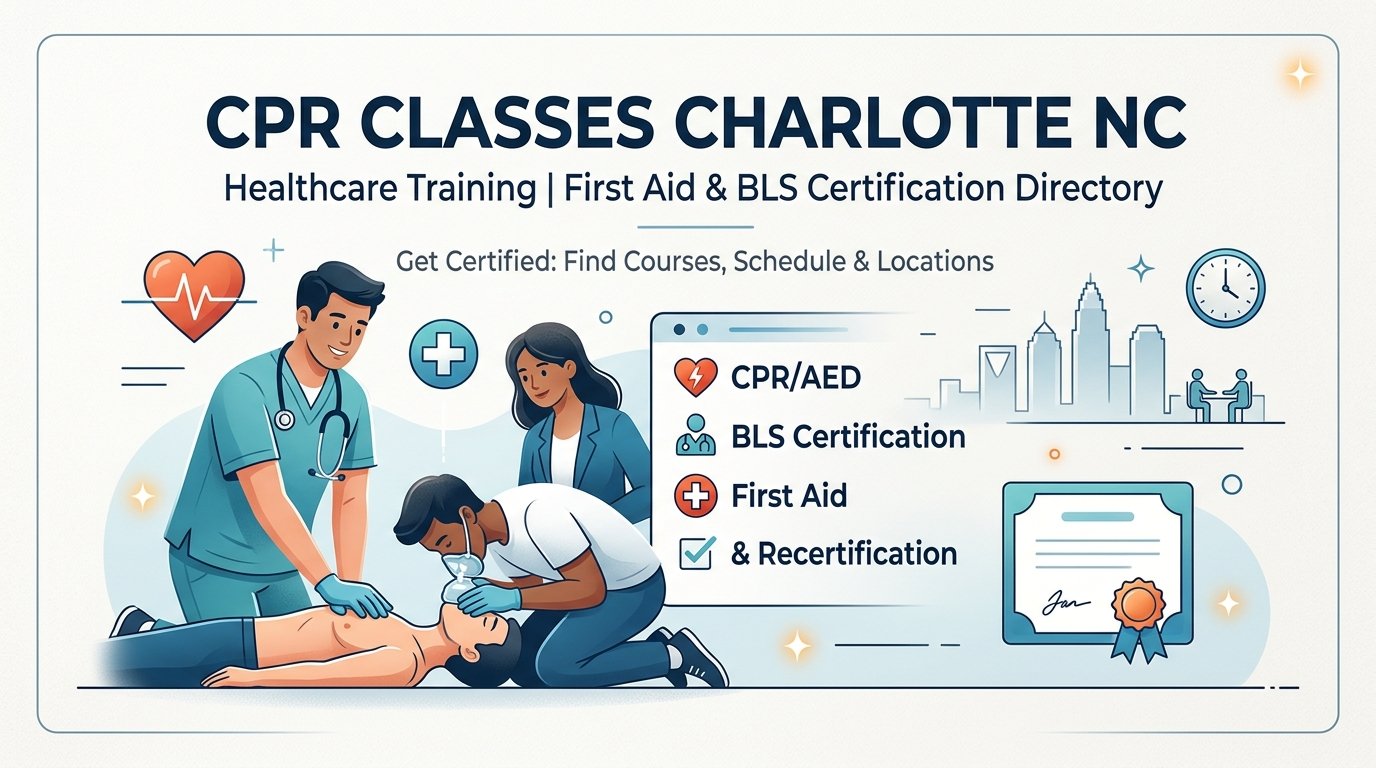
Finding the right CPR classes in Charlotte, NC starts with confirming which course and agency your employer or school requires, then comparing local options by date, price, and format. This guide walks through seven strategies that help students, workplaces, and parents avoid paying for a card that won't be accepted.
If you're looking for CPR classes in Charlotte, NC, the fastest path is to confirm which course and agency you need first, then compare local classes by date, price, and format. Skipping that order is how people end up paying for a card their employer or school won't accept.
CPR stands for cardiopulmonary resuscitation. An AED is an automated external defibrillator, the device that can shock the heart back into a normal rhythm. These seven strategies work for students, workplaces, and parents, and they follow the order that saves the most time and money.
1. Confirm the exact course name before you search
"CPR required" can mean several different courses. Basic Life Support (BLS) is a healthcare provider level course with team-based skills and rescue breathing techniques. CPR AED is aimed at the general public and workplaces. First Aid | CPR AED adds bleeding, burns, choking, and other injury care. Pediatric First Aid | CPR AED focuses on infants and children. Cards from these courses aren't interchangeable, and BLS and CPR AED are not the same thing.
Suppose a nursing student sees "CPR required" in a program handbook and assumes any class will do. She books a general CPR AED class, then learns the program wants BLS for healthcare providers. She pays twice.
To avoid that, work through these steps:
- Find the requirement in your job offer, program handbook, or licensing board page.
- Copy the exact course title, word for word.
- If the wording is vague, email HR or your program coordinator and ask which course and which agency they accept.
- Save the reply so you can show it to a provider if questions come up.
The common mistake is booking a general CPR class when the requirement is BLS, or the reverse. If you want a deeper breakdown of how CPR vs BLS certification differ, read that guide first. Requirements vary by employer, school, and state, so don't guess from a friend's experience.
You'll know this is working when you can name the exact course title and have written confirmation from your employer or program.
2. Check which agency your employer or school accepts
The course name tells you what to learn. The agency tells you whose card counts. The American Heart Association (AHA), the American Red Cross, and the Health & Safety Institute (HSI) all offer CPR and first aid courses, and each is widely used. Some employers accept any of them. Others name one. Stay neutral and let the requirement decide, not brand reputation.
For example, imagine an employer's policy lists two accepted agencies. The employee filters Charlotte classes to those two agencies and registers without worry. A coworker who picked the cheapest class without checking ends up with a card HR won't accept.
Here's how to handle it:
- Ask HR or your program in writing which agencies are accepted.
- Ask whether the course must be the agency's own named course, such as a specific BLS title.
- Use the agency filter on CPR Class Listing to narrow Charlotte results to accepted agencies.
The common mistake is choosing a class on price alone. A $15 savings means nothing if the card is rejected and you retake the class. If HSI is on your list, it helps to see whether HSI CPR certification is accepted by the type of employer or board you answer to.
To measure success, check your shortlist. Every class on it should come from an accepted agency.
3. Choose the right format: in-person, blended, or online-only
Most formats fall into three groups. In-person classes cover everything in a classroom with an instructor. Blended classes put the lesson online and finish with a hands-on skills session. Online-only classes have no hands-on check. Many employers and licensing boards require hands-on practice with a manikin, so online-only often isn't accepted. Don't assume it works everywhere.
Imagine a busy daycare worker who picks a blended class. She finishes the online lesson at home over two evenings, then books a short in-person skills session on a Saturday. She saves classroom time and still meets a hands-on requirement.
Put it into practice this way:
- Ask your employer or board whether a hands-on skills check is required.
- If yes, choose in-person or blended.
- For blended, confirm skills session dates before you start the online portion, since some sessions fill up.
- Ask the provider how long the online part stays valid after you finish it.
The common mistake is paying for an online-only class the employer doesn't accept. Refunds are the provider's call, and many won't give one. Read up on whether online CPR certification is accepted by employers before you commit, and see how a blended CPR course works if you're leaning that way.
Measure it simply: your chosen format is confirmed as acceptable by your employer or licensing board before you pay.
4. Compare local classes by date, price, and location in one place
Once you know the course, agency, and format, you're ready to compare. Looking at Charlotte classes side by side shows real differences in date, price, and location that a single provider's website can't. CPR Class Listing is a directory, so you compare classes there and then register directly with the provider. It doesn't take bookings or payments.
For example, imagine a reader who filters Charlotte results by date and agency and finds three BLS options. One looks cheapest, but it charges extra for the manual. Another includes the card and manual in the price. Once she adds up the total, the second one costs less.
Here's a simple process:
- Search CPR Class Listing for Charlotte.
- Filter by course, agency, format, and date.
- Open two or three providers and ask what the price includes.
- Register with the provider you pick.
As of 2026, most CPR and first aid classes cost roughly $45 to $110, while BLS, ACLS, and PALS usually cost more. ACLS is Advanced Cardiovascular Life Support, and PALS is Pediatric Advanced Life Support. Both are for healthcare professionals and are typically more advanced than BLS. Prices vary by provider, so treat these as ballpark figures.
The common mistake is comparing only the headline price and missing separate fees for the skills check, manual, or card. Ask about each one. If you're also weighing options elsewhere in the Carolinas, our guide to CPR classes in Charleston, SC shows how the same comparison steps play out in another market.
You're done when you have at least three comparable options, with total cost, date, and location noted for each.
5. Pick a class length and time slot that fits your schedule
A class you can't attend on time doesn't help you. Length varies by course. A basic CPR AED class is usually shorter than a First Aid | CPR AED class, and BLS or advanced courses can run longer. Providers list the length on each class, so check it against your day, not just the start time.
Suppose someone has a job start date in four weeks. She books a weekend class right away, leaving buffer in case the class is rescheduled or she gets sick. Her coworker waits, and the only classes left are on weekdays across town.
To plan well:
- Write down your deadline.
- Check the class length listed by the provider.
- Pick a day and location with realistic travel time, including Charlotte traffic at your arrival hour.
- Book early, and confirm the provider's policy on rescheduling.
The common mistake is waiting until the last week and finding only inconvenient or full classes. Seats tend to shrink fast near month ends and hiring seasons.
A good test: your class is booked at least two weeks before your deadline.
6. Arrange a group or on-site class for your workplace
When several employees need certification, one group class often beats sending people out one by one. Some training providers in the Charlotte area offer group or on-site classes, where the instructor comes to you with equipment. It cuts travel, keeps the team on one schedule, and can lower per-person cost.
Imagine a small office with ten employees. The manager requests quotes from several providers for an on-site First Aid | CPR AED class. She compares group pricing and card turnaround, then picks the one that fits her budget and timeline.
The sequence looks like this:
- Count participants.
- Confirm the course and agency your workplace requires.
- Contact providers for quotes.
- Ask about minimum group size, equipment, and how cards are issued.
- Schedule the class and send attendees the details.
The common mistake is assuming one course fits every role. Some staff may need BLS while others only need CPR AED. Sort employees by requirement first, and book separate sessions if needed. Employers sorting out obligations can review first aid, CPR, and AED certification for the workplace and what OSHA first aid and CPR requirements for employers actually say.
You'll know it worked when everyone who needs certification is scheduled and each person's course matches their role's requirement. Providers can list group options on CPR Class Listing, so it's worth checking there as you gather quotes.
7. Track your expiration date and renew before it lapses
Certifications are typically valid for 2 years, and the date is printed or recorded on your card. Renewal or recertification classes are often shorter than first-time courses, but some providers or employers may require a full course if your card has lapsed. Policies differ, so ask.
For example, imagine a coach who sets a reminder 90 days before her card expires. She finds a class, books it with weeks to spare, and never has a gap in coverage.
Keep it simple:
- Record the expiration date from your card the day you get it.
- Set reminders at 90 and 60 days.
- Ask the provider about renewal class options and policies.
- Book the renewal using the same steps as above: confirm the course, agency, and format first.
The common mistake is letting the card expire and having to retake a longer course or miss a work shift. A lapse can also mean a gap in compliance for jobs that require current certification.
The measure is straightforward: a renewal class is booked before your card's expiration date.
Start with the course and agency, then pick a Charlotte class
If you only do three things, do them in this order. Confirm the exact course and agency first, since everything else depends on them. Then choose the format your requirement allows. Finally, compare Charlotte classes for date, price, and total cost. The other strategies, scheduling, group training, and renewals, help you stay on time and avoid repeat costs.
Looking for a CPR, BLS or first aid class near you? Search upcoming classes on CPR Class Listing to compare dates, prices and certifying agencies from local training providers, then register directly with the provider in minutes.
- Uncategorized
- cpr classes charlotte nc
Written and reviewed by the CPR Class Listing editorial team against the listings in the directory. How we verify providers.
Ready to get certified?
Search upcoming CPR, BLS and first aid classes near you and register directly with a local provider.
Find a class near you