7 Strategies to Find the Right CPR Classes in Charleston, SC
October 25, 2026 · Written by CPR Class Listing
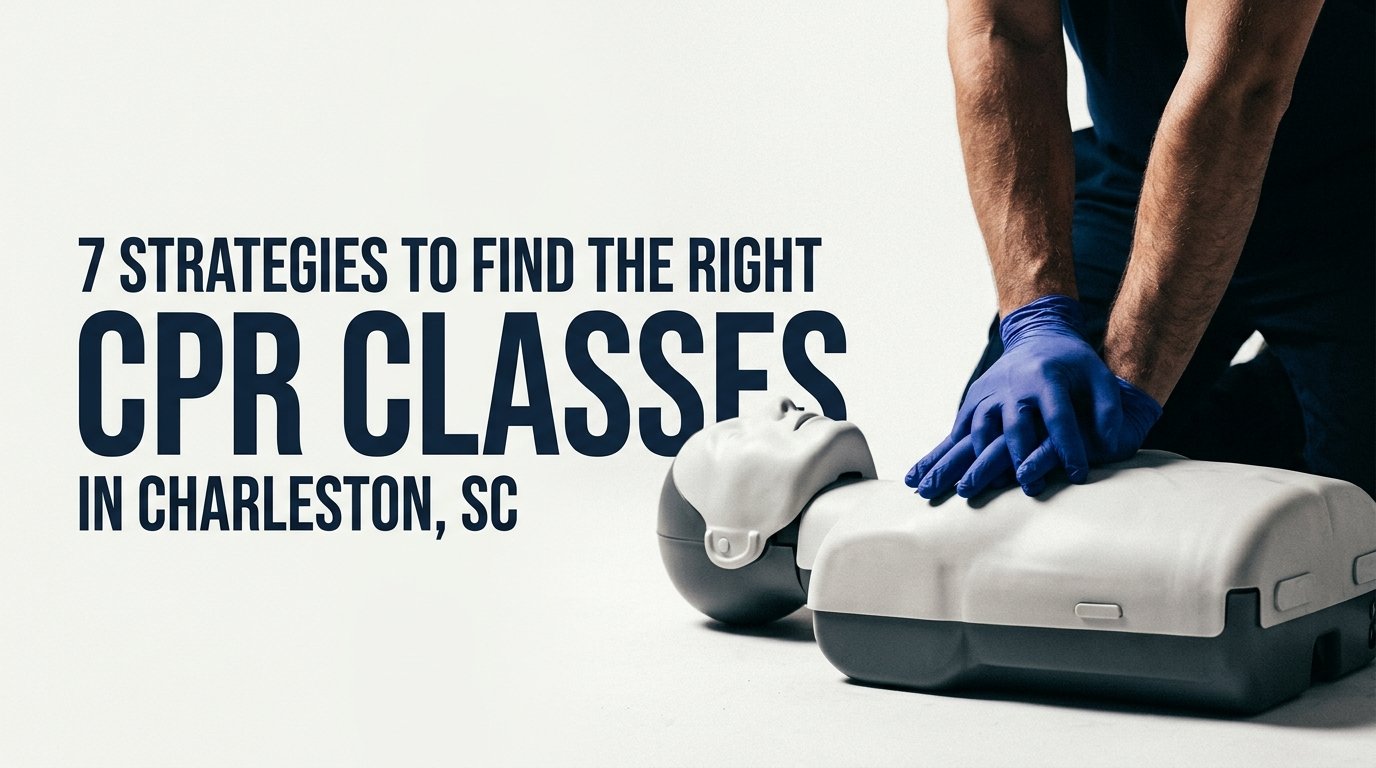
Choosing among CPR classes in Charleston, SC is easier when you put card acceptance ahead of convenience. This guide gives seven strategies for confirming what your employer or licensing board requires, comparing BLS and Heartsaver options, and booking a course that earns a card accepted the first time.
Searching for CPR classes in Charleston, SC returns a long list: hospital-affiliated courses, technical college programs, independent instructors, and mobile trainers who come to your workplace. Many of them teach sound CPR. Fewer of them issue a card that your employer, nursing program, or licensing board will accept, and that gap is where most people lose money and time.
A few terms help before you compare anything. CPR is chest compressions and rescue breaths for someone in cardiac arrest. BLS (Basic Life Support) is the healthcare-provider level of CPR, with team-based response and advanced airway steps. Heartsaver is the American Heart Association's name for its lay-rescuer CPR, AED, and first aid courses. An AED is the automated defibrillator found in offices, gyms, and schools. Blended learning means online coursework followed by an in-person skills session. The seven strategies below put acceptance first and convenience second.
1. Confirm Which Certification Your Employer or Board Actually Requires
Imagine a Charleston nursing student who assumes any CPR card will do. She books an inexpensive community class, completes it, and submits her card before clinical rotations. The program coordinator rejects it: the program requires a BLS Provider course, and she has to pay for and sit through a second class. Nothing was wrong with the first class. It was simply the wrong course.
This happens because "CPR" is an umbrella term. Community CPR and healthcare-level BLS differ in content, in who they are designed for, and in what they qualify you to do. If you want a deeper breakdown, this guide to CPR vs BLS certification explains the differences. Requirements are set by whoever asks for the card, not by the class you happen to find first, so the requirement has to come before the search.
- Email your HR contact, program coordinator, or licensing board before you look at any listings.
- Ask for the exact course name, the required certifying agency, and whether a hands-on skills component is mandatory.
- Ask whether blended learning is accepted or only fully in-person classes.
- Save the reply in writing, and keep it with your registration confirmation.
The most common mistake is booking a general community CPR class when a healthcare-level BLS course is required. Another is relying on a coworker's memory of what "worked last time," since policies change. Healthcare students at institutions such as MUSC or Trident Technical College should check their own program handbook and coordinator rather than assume.
To know this is working, look for two things: written confirmation that your chosen course is accepted, and zero rejected cards.
2. Choose the Certifying Agency That Fits Your Purpose
The two names you will see most often are the American Heart Association (AHA) and the American Red Cross. Both run established programs, and many employers accept either, but some specify one by name. Healthcare employers and clinical programs commonly ask for AHA BLS. Workplaces and community groups often accept Red Cross as well. The agency matters because the requester, not the student, decides what counts.
For example, imagine a clinic manager whose written policy specifies AHA BLS for all clinical staff. Rather than scrolling every Charleston result, she filters directory listings by agency and sees only AHA-aligned courses. She saves an hour and avoids a mismatch.
To put this into practice:
- Use the agency's own course finder to see which sites in the Charleston area are authorized.
- Filter directory listings by agency so you compare like with like.
- Ask the provider directly whether they are an authorized training site, and which agency's card you will receive.
The pitfall is choosing a provider that issues its own unaffiliated card because it is cheaper or faster. Those cards may look professional, but they carry no agency authorization, and many employers and boards will not accept them. Wording such as "nationally accepted" or "OSHA compliant" is not the same as being an authorized site of a named agency.
Your measure is simple: the provider can be verified as authorized, and the person requesting your card confirms it is acceptable.
3. Match the Format: In-Person, Blended, or Skills-Only
Most certifying agencies offer the same course in more than one format. Traditional classes are fully in-person and typically run longer. Blended learning moves the lecture and video content online, which you complete at your own pace, and leaves a shorter hands-on skills session with an instructor. Some providers also offer skills-only sessions for people who completed the online portion elsewhere. All formats can lead to the same card when the course is authorized, but a course with no hands-on evaluation is a different matter.
Consider a shift nurse with a rotating schedule. She completes the online modules at home between shifts, then attends a roughly 45-minute in-person skills session on a day off. She spends less time in a classroom and still demonstrates compressions and ventilations to an instructor. (Session lengths vary by provider and course, so confirm yours.)
Steps to follow:
- Confirm with your requester that the format you want is accepted.
- Finish the online modules before your skills date, since many providers require completion first.
- Bring your online completion certificate to the session if the provider asks for it.
The costly mistake is paying for an online-only course that lacks a hands-on skills test. This is tied to a widespread misconception that online-only certificates are universally accepted. They are not, and healthcare employers and many licensing boards specifically require an in-person skills check. Learn more about how CPR certification works before you pay for any course.
Track the total time you spend across online and in-person portions, and check that a hands-on evaluation appears on your card record.
4. Compare Providers by Location, Schedule, and Class Size
Once acceptance is settled, convenience decides between qualifying options. Charleston is geographically awkward: the peninsula has limited parking and bridge traffic, while Mount Pleasant, North Charleston, West Ashley, James Island, and Summerville each have their own commuting patterns. A class that looks close on a map can take far longer at 8 a.m. on a weekday.
For example, imagine a Mount Pleasant resident who finds two qualifying classes. One is a weekday session on the peninsula, the other a Saturday class in town. She picks Saturday, avoids the bridge commute and paid parking, and arrives relaxed.
How to compare:
- List three or four providers that meet your requirement.
- For each, note realistic drive time at the actual class hour, not off-peak.
- Record available dates inside your window, and the class size.
- Ask about waitlists, rescheduling, and cancellation terms.
The mistake to avoid is ignoring commute and parking, then arriving late. Many providers require on-time arrival for skills practice and may not admit latecomers, which can forfeit the fee. Ask about the late policy before you pay.
Measure drive time, the number of open dates in your window, and the student-to-manikin ratio. Details like schedules and class sizes change often, so confirm them directly with each provider as of the date you book.
5. Vet the Instructor and the Training Equipment
CPR is a motor skill. You learn compression depth, rate, and recoil by doing them, and quality depends on how much time your hands are actually on a manikin. Two classes with the same agency and the same price can differ greatly in practice time depending on the instructor and the equipment.
Imagine a daycare director arranging staff training. Before booking, she asks whether the provider brings infant manikins and AED trainers, since her staff care for babies and toddlers. The provider confirms both, and she books with confidence. A provider that only brought adult manikins would have left her team untrained for their most likely scenario.
Questions to ask before you book:
- Is the instructor currently authorized by the certifying agency?
- Which manikins are used: adult, child, infant?
- Do manikins have feedback devices that show compression rate and depth?
- Is an AED trainer provided, and does each student practice with it?
- What do recent reviews say about pacing, equipment, and instructor attitude?
The usual mistake is choosing on price alone and discovering that several students share one manikin, leaving each with a few minutes of practice. Read reviews for patterns across several months, not a single glowing or angry comment. If you are curious how instructors earn their authorization, see the overview of CPR instructor certification.
To measure it, estimate hands-on minutes per student and note recurring review themes from recent months.
6. Understand Total Cost, Card Delivery, and Renewal Terms
The advertised price is rarely the whole price. Some providers charge separately for the student manual, the online module, the skills session, or the card itself. Others bundle everything. Because fees vary and change, only an itemized quote tells you what you will actually pay.
For example, imagine two classes advertised at similar prices. One includes the eCard and the course book. The other adds a manual fee and a card fee at checkout, which makes it noticeably more expensive. The cheaper-looking option was not cheaper.
Steps to take:
- Request an itemized price covering every fee.
- Ask when the eCard is issued after the class, since some employers need proof quickly.
- Record the expiration date the day you receive the card.
- Set a calendar reminder a couple of months before it lapses.
AHA and Red Cross certifications are typically valid for two years, but verify current policy on each agency's site, because terms can change. Certification does not last forever, and that is a common misconception. The pitfall is letting a card lapse. Many providers offer shorter renewal courses only for people with a current card, so a lapse can mean repeating the full course.
Measure the all-in cost per certified person and the number of days from class to card in hand.
7. Book Group Training for Your Charleston Workplace or Team
When several employees need certification, a group class is often more efficient than sending people one at a time. Many providers will teach at your site or in a private session. That cuts travel, keeps staff together, and lets you schedule around operations instead of someone else's calendar.
Imagine a restaurant group that schedules an on-site session during a slow weekday morning to certify a dozen staff. Nobody loses a shift to a commute, and the whole team shares the same expiration date, which simplifies tracking.
A workable sequence:
- Gather headcount and confirm the required course for each role.
- Request quotes from several providers.
- Confirm minimum and maximum class sizes, travel fees, and equipment brought on site.
- Check space needs, since students need room to kneel at manikins.
- Schedule renewals together, and put the expiration date on a shared calendar.
The expensive error is booking the wrong course for the whole team without first confirming industry requirements. A childcare center, a dental office, and a restaurant may each need something different, and a mistake multiplies across everyone enrolled. Apply strategy 1 before you request a single quote.
Track the percentage of required staff who are currently certified, and keep upcoming expirations visible so none are missed.
Start With the Course and Agency, Then Compare the Rest
If you do only two things, do the first two: confirm the required course and the accepted agency in writing. Everything else, including format, location, class size, and price, only matters among classes that qualify. A cheap, convenient class that your employer rejects is the most expensive option on the list.
Once you know what you need, comparing Charleston providers becomes quick and low-risk. Search upcoming classes on CPR Class Listing to compare dates, prices and certifying agencies from local training providers, then register directly with the provider in minutes. Looking for a CPR, BLS or first aid class near you? Start there.
- Uncategorized
- cpr classes charleston sc
Written and reviewed by the CPR Class Listing editorial team against the listings in the directory. How we verify providers.
Ready to get certified?
Search upcoming CPR, BLS and first aid classes near you and register directly with a local provider.
Find a class near you