Stop the Bleed Class: What to Expect From Start to Finish
November 3, 2026 · Written by CPR Class Listing
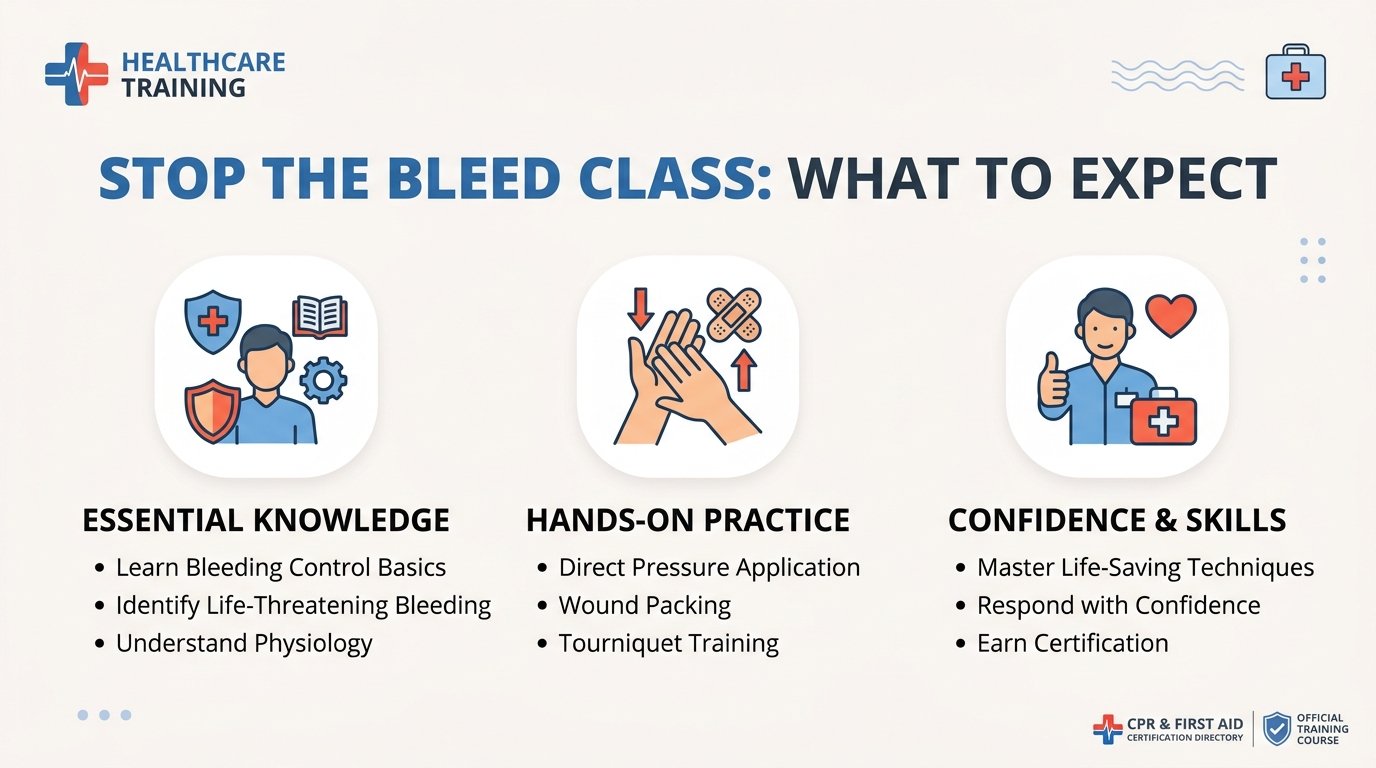
A Stop the Bleed class is a short, hands-on course, usually 60 to 90 minutes, that teaches anyone to control severe bleeding until help arrives. This guide covers the stop the bleed class what to expect, including who should attend, the three skills you'll practice, whether you get a card, and how to find a session near you.
A Stop the Bleed class is a short, hands-on course that teaches you how to control severe bleeding until emergency responders arrive, and most people finish in about 60 to 90 minutes. You don't need any medical background. You learn three physical skills, practice them on training models, and leave knowing what to do if someone near you is bleeding badly.
It's often confused with CPR, and it isn't the same thing. This article explains who the class is for, what happens in the room, what you'll practice, whether you get a card, and how to find a session near you.
What is a Stop the Bleed class, and who should take it?
Stop the Bleed is a bleeding control training program. It teaches everyday people to recognize life-threatening bleeding (also called severe hemorrhage) and act before paramedics arrive. The national campaign launched in 2015 with support from the White House, and the American College of Surgeons Committee on Trauma is closely associated with the course content. Details of the program have evolved since then, so ask your host which version of the curriculum they teach.
The idea behind it is simple. Severe bleeding can become life-threatening in minutes, and help doesn't always arrive that fast. Someone nearby who knows what to do can make a real difference.
The audience is broad. Classes are common for:
- Teachers and school staff
- Office and facility staff
- Faith and community groups
- Coaches and youth sports volunteers
- Security officers and event staff
- Anyone in the general public who wants to be prepared
Healthcare workers take it too, but it's built for people with no clinical training.
One thing to get straight early: this is a bleeding control course, not CPR. You won't learn chest compressions or rescue breathing, and many classes don't result in a CPR card of any kind. Cost depends on who hosts the class. Some sessions are offered free by hospitals or community groups, while private providers may charge a fee. Check the listing or ask the provider before you register.
What happens during a Stop the Bleed class?
Most classes follow the same three-part flow. First comes a short presentation or video on recognizing life-threatening bleeding. Then you move into guided hands-on practice. The session usually ends with time for questions.
The lecture portion is often brief. Most of the time goes to practice, because the skills are physical and only stick when your hands have done them. Expect to spend far more time kneeling over a training model than sitting in a chair.
For each skill, the instructor demonstrates the steps first. Then you try it yourself on training models or simulated wounds, and the instructor or an assistant watches and corrects as you go. Feedback is immediate and specific. If your hands are in the wrong spot or your wrap is loose, someone will tell you.
Length, size, and format
Length, class size, and format vary by host. Most classes run roughly one to two hours. A hospital might run a large session in an auditorium with several instructors circulating. A fire department or private trainer might teach a dozen people around a table. Smaller groups generally mean more one-on-one coaching.
Some programs split the course into a self-paced online portion plus an in-person practice session. Others are entirely in person. If a provider describes a class as online only, check what you'd actually be getting, since the hands-on practice is the heart of the course. The listing should state the format, and if it doesn't, ask the provider.
No one is graded in a way that should worry you. The goal is that you can perform each step correctly by the end, and instructors generally work with you until you can.
What skills will you practice?
Three core skills make up the course:
- Direct pressure. Pressing firmly on the wound with your hands or a dressing to slow or stop the bleeding.
- Wound packing. Filling a deep wound with gauze or a hemostatic dressing (gauze treated with an agent that helps blood clot), then pressing on it.
- Tourniquet use. Applying a commercial tourniquet, a band with a tightening mechanism, to an arm or leg to stop blood flow to a severe wound.
The usual sequence
Classes generally teach these in order of escalation. You call 911 or make sure someone else does. You find where the bleeding is coming from, which can mean exposing the wound. You apply firm direct pressure. If pressure isn't enough, you move to packing a deep wound or applying a tourniquet to a limb.
That framework is easy to remember, and instructors drill it so you can run through it under stress. Many courses use a short memory aid for it, and yours may phrase it a little differently.
What tourniquet practice looks like
You'll typically practice on a training arm or leg, or sometimes on a classmate with an unfastened device. The instructor will show you where to place it: high on the limb, above the wound and not on a joint. You tighten it until the bleeding stops, secure it, and note the time it was applied so responders know how long it's been on.
A common misconception is that tourniquets are always dangerous or a last resort only. Current bleeding control training treats them as a standard, effective tool for life-threatening limb bleeding. Your instructor will explain when to use one and when not to, and that guidance is what governs. This article describes what classes generally cover, not medical advice, so follow your instructor's teaching and, in a real emergency, call 911.
Packing a wound can feel awkward at first. You'll feed gauze into a simulated wound with your fingers and then hold firm pressure. Most people find that it gets easier after one or two tries.
Do you get a certification card, and how long does it last?
It depends on who runs the class. Many hosts give a completion certificate or card, but it isn't a certification in the same sense as a CPR or BLS (Basic Life Support) card. Policies vary by instructor and host, and some classes give nothing at all. If you need proof of attendance, confirm that before you register.
Expiration works differently too. CPR cards are typically valid for 2 years. Stop the Bleed completion usually doesn't carry a standard expiration date. Even so, skills fade without practice, and curriculum details can change. Refreshing every year or two is a sensible habit. Ask your provider whether they set their own validity period or offer refresher sessions.
Work and school requirements
If you're taking the class for a job, a school district, or a licensing requirement, ask the requiring party first whether this course satisfies it. Requirements vary by state and employer, and some organizations have their own internal training policies. Don't assume a certificate from one provider will be accepted everywhere.
Also keep in mind that Stop the Bleed isn't interchangeable with other courses. If your employer requires First Aid | CPR AED (Automated External Defibrillator) or BLS, a bleeding control class won't replace it. The reverse is also true. Confirm the exact course name, agency, and format your employer expects, then match your registration to it.
How is Stop the Bleed different from CPR and first aid classes?
The biggest difference is focus. Stop the Bleed covers severe bleeding and nothing else. CPR AED classes cover cardiac arrest, using an AED, and choking. First Aid classes cover a wider range of injuries and illnesses, such as burns, fractures, allergic reactions, and sudden medical problems.
Length and cost differ as well. Stop the Bleed is usually shorter than a full CPR or first aid course. Most CPR and first aid classes run about $45 to $110, and BLS, ACLS (Advanced Cardiovascular Life Support), and PALS (Pediatric Advanced Life Support) cost more. Stop the Bleed pricing varies widely by host, from free community sessions to paid private classes, so check each listing.
Many first aid courses from the American Heart Association (AHA), the American Red Cross, and Health & Safety Institute (HSI) include a bleeding control segment. It's usually less in-depth than a dedicated class, with less time spent on packing and tourniquet practice. Read the course description to see what's actually covered, and ask the provider if it isn't clear.
The courses work well together. A workplace might train staff in First Aid | CPR AED to cover the most common emergencies, then add Stop the Bleed for deeper bleeding skills. A teacher or coach might do the same. Each fills a gap the other leaves.
Choosing between them comes down to what you need. If a job or license requires a card, start with the required course. If you want broader preparedness, consider both.
How do you find a Stop the Bleed class and get ready for it?
Classes are offered by hospitals, trauma centers, fire departments, community groups, and private training providers. Availability varies by area, and some regions have frequent sessions while others have only occasional ones.
CPR Class Listing is a national directory where providers list classes and students compare them by date, price, format, and agency. You then register directly with the provider. The directory doesn't teach classes, take bookings, or process payments, so questions about the session itself go to the provider.
Before you go
- Wear comfortable clothes. You'll kneel and work on the floor.
- Ask about equipment. Find out whether you'll practice with real commercial tourniquets or training versions.
- Ask about class size. Smaller groups usually mean more individual feedback.
- Confirm the card policy and cost. Do this before you register, not after.
The simulated wounds are training props, and most people find the class calm and practical rather than graphic. If you're worried, ask the provider what the materials show.
Groups and training providers
If you're organizing training for a school, business, or congregation, ask providers about on-site sessions. Many will come to you, which saves everyone travel time. If you teach Stop the Bleed or related courses, listing your classes in the directory helps local students find them.
Short, practical, and worth confirming before you sign up
A Stop the Bleed class is brief and focused: you learn three skills, practice them with your own hands, and leave more prepared than you arrived. Before you register, confirm the length, card policy, and cost with the provider, since all three vary by host.
Looking for a CPR, BLS or first aid class near you? Search upcoming classes on CPR Class Listing to compare dates, prices and certifying agencies from local training providers, then register directly with the provider in minutes.
- Uncategorized
- stop the bleed class what to expect
Written and reviewed by the CPR Class Listing editorial team against the listings in the directory. How we verify providers.
Ready to get certified?
Search upcoming CPR, BLS and first aid classes near you and register directly with a local provider.
Find a class near you