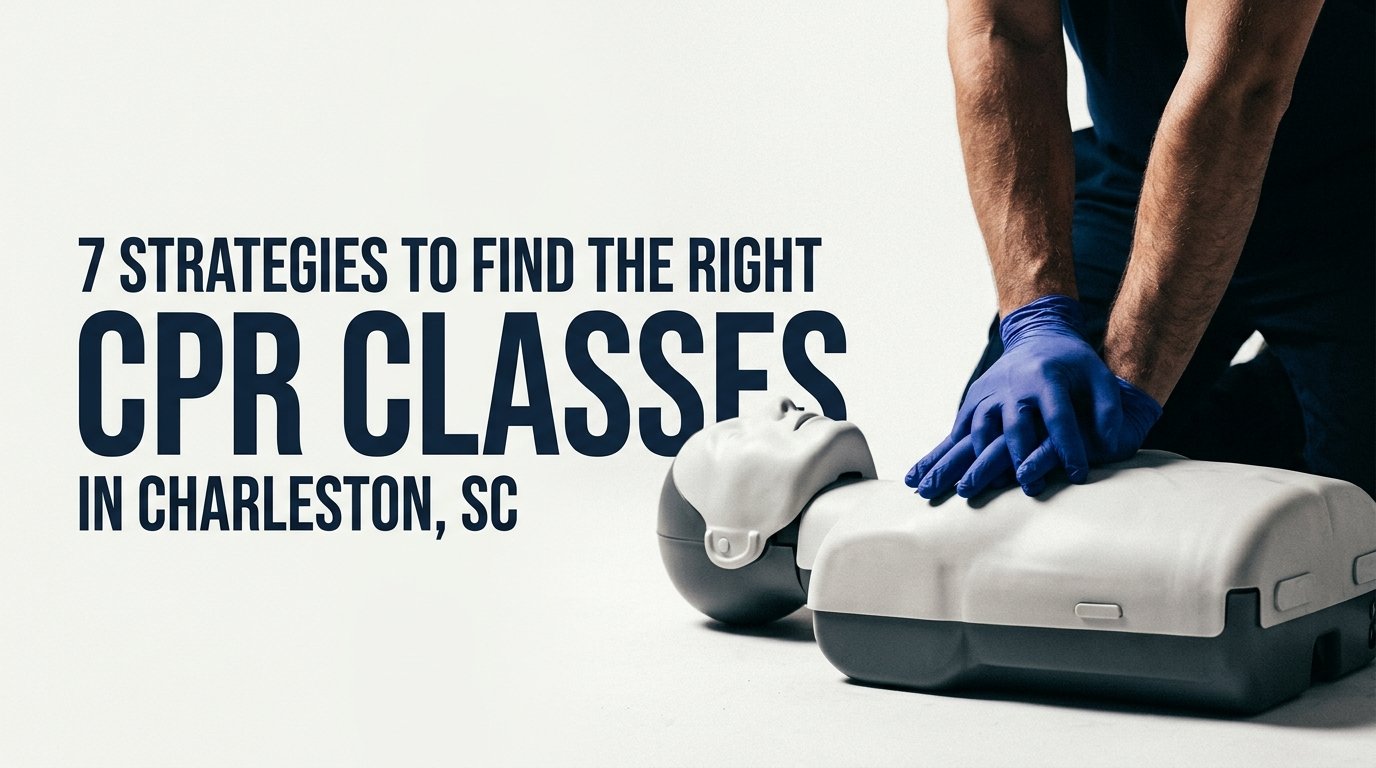
7 Strategies to Find the Right CPR Classes in Boston
November 1, 2026 · Written by CPR Class Listing
Finding the right CPR classes in Boston starts with confirming which course and agency your employer, school, or licensing board requires. This guide walks through seven strategies for comparing local classes by date, price, format, and location so you register for a card that will actually be accepted.
If you're looking for CPR classes in Boston, start by confirming which course and agency you need. Then compare local classes by date, price, format, and location, and register directly with the provider. CPR stands for cardiopulmonary resuscitation, and the right class depends on who is asking for your card. These seven strategies follow that order, so you end up with a class your employer, school, or licensing board will accept. CPR Class Listing is a directory, so it doesn't teach classes or take bookings. It helps you see the options in one place.
1. Confirm Which Course and Agency You Need Before You Search
"CPR class" covers a lot of ground. A community CPR AED course (AED means automated external defibrillator) is not the same as Basic Life Support (BLS), which is built for healthcare providers. Advanced Cardiovascular Life Support (ACLS) and Pediatric Advanced Life Support (PALS) go further still. Employers and schools usually name one specific course and often one agency, such as the American Heart Association (AHA), the American Red Cross, or the Health & Safety Institute (HSI).
For example, imagine a nursing student in Boston who books a general CPR class because it's cheap and close by. Later she learns her program requires BLS. The class doesn't count, and she pays for a second one. This is an illustration, but it's a very common way people lose money.
To avoid it, get the requirement in writing before you search:
- Email or call your employer, school, or licensing board.
- Ask for the exact course name, the accepted agency or agencies, and the format allowed (in-person, blended, or online).
- Ask whether a hands-on skills check is required.
- Save the reply and use it as your filter for every search.
The mistake to watch for is searching for the cheapest "CPR class" without checking that it matches what's required. Price only matters after the course is right.
You'll know this is working when you have a written requirement in hand and every class on your shortlist matches it. Requirements vary by employer and state, so don't guess from what a coworker took.
2. Pick the Right Format: In-Person, Blended, or Online-Only
Classes come in three main formats. In-person classes do everything in a room with an instructor. Blended classes have you finish an online lesson on your own time, then attend a shorter hands-on skills session. Online-only classes have no hands-on part at all.
The hands-on piece matters because compressions and breaths are physical skills. That's why many employers and boards require an instructor to watch you practice on a manikin, and why online-only cards are often not accepted for work or school requirements. Some people do take online-only courses for personal knowledge, and that can be fine when no one is requiring the card.
Suppose a shift worker picks blended learning. She finishes the online lesson at home after her kids are asleep, then attends a short skills session on a Saturday. She saves time without giving up the hands-on check her employer wants.
To choose well:
- Look at the written requirement from Strategy 1 and note whether a skills check is needed.
- Filter listings by format.
- For blended classes, confirm how the skills session is scheduled and how long it runs.
- Ask whether the online portion must be finished before you arrive.
The costly mistake is paying for an online-only course the employer won't accept. Your measure is simple: your chosen format is confirmed as accepted before you pay.
3. Compare Boston Classes by Date, Price, Format, and Agency Side by Side
Looking at one provider's page at a time makes it hard to tell whether a price is good. Seeing several classes together shows the spread in dates, agencies, and what's included. As of November 2026, most CPR and first aid classes run roughly $45 to $110, while BLS, ACLS, and PALS usually cost more. Prices change, so check each listing.
Here's an illustration of how a simple comparison might look for three imagined Boston-area classes:
- Class A: BLS, AHA, in-person, a Tuesday evening, card included.
- Class B: BLS, Red Cross, blended, flexible online part plus a Saturday skills session, manual sold separately.
- Class C: BLS, HSI, in-person, a weekday morning, card fee added at checkout.
The lowest headline price might not be the lowest total once card and manual fees are added, and the agency may not be the one you were told to get.
Browse CPR Class Listing for Boston, shortlist three classes that match your requirement, and write down the total cost for each, including any card or manual fees. Then register directly with the provider you choose.
The common mistake is comparing only the headline price. You'll know you've done this well when you can name the total cost and the agency for every class on your shortlist.
4. Choose a Boston Location That Fits Your Commute and Schedule
A class you can't comfortably reach is a class you might miss. Many courses start on time and lock the door, and a late arrival can mean losing your seat or your fee. Getting to Boston-area locations varies a lot by transit line, traffic, and parking.
Imagine a student who compares two classes. The cheaper one needs a long drive and paid parking. The other costs a bit more but is steps from an MBTA stop. Once the parking fee and the extra hour are counted, the pricier class is the better deal. This is an illustration, but the math holds up often.
Work through it like this:
- Map each shortlisted location.
- Estimate door-to-door travel time at the hour you'd actually travel, not at midday.
- Price out parking or transit fares.
- Check the start time and the provider's late-arrival policy.
- Confirm the address on the listing, since some providers teach at several sites.
The mistake is ignoring travel time and parking when you compare price. Set a limit before you start, such as 45 minutes each way or a maximum total spend. You're on track when travel time and total cost, parking included, both fall within that limit.
5. Verify the Certification Card Will Be Accepted Where You Need It
Strategy 1 tells you what the requirement is. This step checks that a specific class meets it. A provider calling a course "certified" doesn't mean your employer will accept the card. Different cards come from different agencies, and some employers accept several while others accept one.
For example, imagine a childcare worker who finds a class she likes. Before paying, she sends the provider's course description to her director and asks if it meets the center's requirement. The director says yes the same day. If the answer had been no, she'd have saved the fee.
The steps are short:
- Copy the course name, agency, format, and skills-check details from the listing.
- Send them to your requirement source and ask for a yes in writing.
- Ask the provider how and when the card is issued, and whether it's a digital or printed card.
The trap is assuming any card works because the class was cheap or advertised as certified. Rules for childcare, schools, and emergency medical services can differ by state and by employer, so confirm them directly rather than relying on general advice. You're done when you hold written confirmation of acceptance before you pay.
6. Book Early and Plan Around Your Expiration Date
Certifications are typically valid for two years, and many employers don't allow a gap. If your card lapses, you may have to take a longer initial course instead of a shorter renewal, or be pulled from certain duties. Classes also fill up, especially evenings and weekends.
Suppose an employee's card expires in two months. She starts looking right away, books a renewal a month ahead, and notes a backup date in case something comes up. When a work shift conflicts with her first date, she moves to the backup with no stress.
To build that cushion:
- Put your expiration date in your calendar.
- Set a reminder 4 to 6 weeks earlier.
- When you shortlist classes, note one primary date and one backup.
- Read the provider's reschedule and refund policy before you pay.
The classic mistake is waiting until the last week and finding no open dates that fit your schedule. Your measure: the class is booked at least two weeks before your deadline, with a backup option noted.
7. Arrange Group Training If Your Workplace or Team Needs Certification
If several people need certification, one on-site or group session can save time and travel. Providers often come to your location, and some offer per-person pricing that beats individual enrollment once you reach a minimum group size. The catch is that different roles often need different courses.
Imagine an office manager who books one on-site CPR AED session for administrative staff. She sends the clinical staff to BLS classes, because their roles call for a healthcare-provider course. Treating everyone the same would have left the clinicians uncertified for their jobs.
Here's a workable process:
- List who needs which course, using the requirement for each role.
- Ask providers about on-site options, minimum group size, and per-person pricing.
- Compare those quotes against public class costs, including staff travel and time away from work.
- Keep a simple tracker with each person's course, agency, and expiration date.
The mistake is certifying everyone in one course when roles differ. You'll know it's working when every team member holds the course their role requires and each expiration date is tracked.
Where to Start, and Answers to Common Boston CPR Questions
Do strategies 1 and 5 first. Confirm the course, the agency, and that a specific class will be accepted. Then use strategies 2 and 3 to narrow the format and compare real options. Finish with location, timing, and group options. If you only have time for two steps, make them the two that prevent paying twice.
Looking for a CPR, BLS or first aid class near you? Search upcoming classes on CPR Class Listing to compare dates, prices and certifying agencies from local training providers, then register directly with the provider in minutes.
- Uncategorized
- cpr classes boston
Written and reviewed by the CPR Class Listing editorial team against the listings in the directory. How we verify providers.
Ready to get certified?
Search upcoming CPR, BLS and first aid classes near you and register directly with a local provider.
Find a class near you