How to Choose and Complete an OSHA 30 Construction Course (and Add CPR Certification Locally)
October 28, 2026 · Written by CPR Class Listing
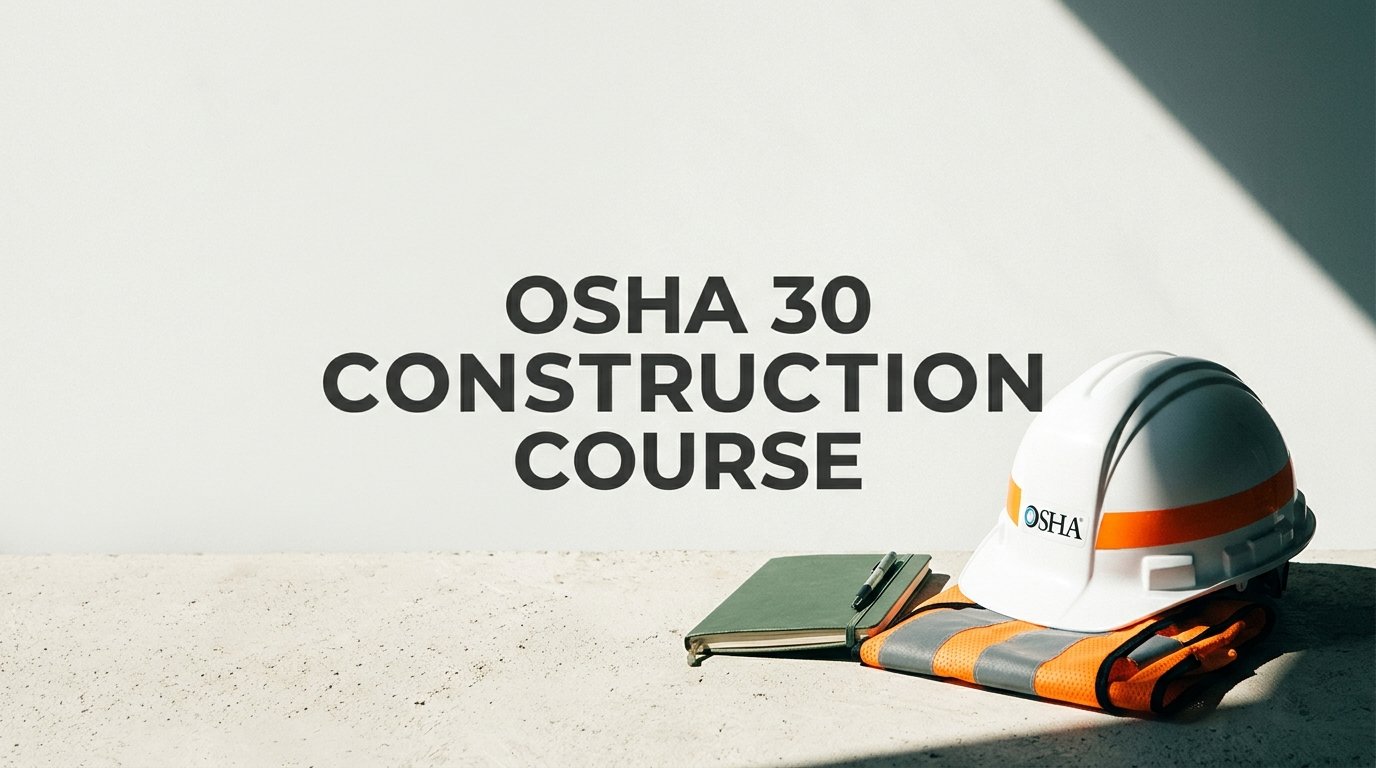
This step-by-step guide shows supervisors and foremen how to confirm they need an OSHA 30 construction course rather than OSHA 10 or general industry, choose an authorized provider, finish the 30 hours, and receive a DOL card. It also explains how to add local CPR and first aid training, which the course does not cover.
An OSHA 30 construction course is the standard training for supervisors, foremen, and anyone with safety responsibility on a job site. This guide takes you from confirming you need the course, through picking a legitimate provider and finishing the 30 hours, to holding your Department of Labor (DOL) card. It then shows you how to add CPR and first aid training locally, which the course does not cover.
Before you start, have a government-issued ID, a reliable internet connection (or a local class schedule), and enough time to study for several days. Online courses cap daily hours, so you can spread the work out, but in-person courses often run six to eight hours a day.
Step 1: Confirm You Need OSHA 30 Construction, Not OSHA 10 or General Industry
OSHA 10 is aimed at entry-level workers. OSHA 30 is aimed at supervisors, foremen, and workers with safety responsibility. Employers, unions, and some jurisdictions decide which one they require, so check your employer's policy or the project contract before you buy anything. Some contracts name the card and the industry track explicitly.
The construction course is a separate track from general industry, and the card is labeled by industry. Taking the wrong one is a common and costly mistake, because a general industry card will not satisfy a construction requirement. If your work involves building, demolition, renovation, or site work, you want construction.
It helps to know what the card actually is. The "OSHA 30 card" is officially a DOL Outreach Training Program completion card. It is proof that you completed the training, not an OSHA certification or a license, and you should avoid describing it that way on a resume or to a client. For a side-by-side look at both course levels, see this overview of OSHA 10 and 30 certification.
Local rules can add to the baseline. New York City, for example, has its own site safety training requirements for many construction workers, and other states and cities have their own mandates. Do not assume your area matches another. Verify with your state or city agency, or ask the general contractor which cards and hours the project requires.
- Ask your employer or union which course level they require.
- Check the contract or site rules for the industry track.
- Confirm any state or city requirements with the relevant agency.
Step 2: Verify the Provider Is OSHA-Authorized
Only trainers and providers authorized through the OSHA Outreach Training Program can issue DOL cards. Before paying, ask for the provider's authorization details and the name of the authorized trainer, then confirm them against OSHA's own information at osha.gov/training/outreach. A legitimate provider will not be bothered by the question.
Red flags
- Promises of an instant card, or a card with no real coursework.
- Prices far below what other providers charge.
- No named authorized trainer.
- No mention of the Outreach Training Program anywhere on the site.
- Claims of "OSHA certification" or "OSHA-approved" training. The correct term is "OSHA-authorized."
OSHA itself warns about fraudulent cards, and its Outreach page explains how to tell valid training from the rest. A fake card can cost you far more than the course fee: a site can turn you away, and you may have to repeat all 30 hours.
Online courses add one more check. They must come from an authorized online provider, not just an authorized trainer who happens to have a website. OSHA's policies on online delivery can change, so confirm current rules with OSHA directly rather than relying on a provider's marketing page. If a provider cannot clearly state who authorizes it, move on. The same scrutiny applies to first aid and CPR training, and this guide on whether online CPR certification is accepted by employers explains what workplaces actually look for.
Step 3: Choose Between Online, In-Person, and Hybrid Delivery
Online courses are self-paced and suit irregular schedules, such as shift work or seasonal slowdowns. Under OSHA's outreach rules, online students face a daily time limit and a window to finish, commonly cited as a maximum of 7.5 hours per day and six months from start to completion. Confirm the current figures with your provider and OSHA, since these policies can change as of 2026.
In-person classes put you in a room with a live trainer. You get hands-on demonstrations, immediate Q&A, and discussion of hazards specific to your trade or region. That format works well for supervisors who want to talk through real site problems, and for employers who want to train a whole crew together at once.
Some providers offer hybrid arrangements, mixing classroom sessions with online modules. Availability varies, so ask whether the combined hours still qualify for a single DOL card from one authorized provider.
Decision factors
- Employer or union preference: some require in-person training outright.
- Learning style: if you retain more through discussion, choose a classroom.
- Group size: an on-site class can be efficient for a crew.
- Schedule: online gives flexibility, in-person gives structure.
Pricing differs by format and provider, and online courses are often cheaper than classroom sessions, though that is not guaranteed. Get quotes from at least two authorized providers as of 2026, and confirm what the fee includes, such as the card itself and any shipping.
Step 4: Register and Prepare Before Day One
Registration asks for a few details, and accuracy matters because they print on your card. Have these ready:
- Your legal name exactly as it appears on your ID.
- A contact email you check regularly.
- A mailing address where the card can actually be delivered.
If you are taking the course online, set up a quiet study space and test the platform and browser before the first session. Confirm any language options, such as Spanish, at registration, since not every provider offers every language.
Know what the course covers. The required topics include an introduction to OSHA, the "Focus Four" hazards, and managing safety and health. The Focus Four are the leading causes of construction deaths: falls, electrocution, struck-by incidents, and caught-in or caught-between incidents. The trainer then chooses elective topics to reach the full 30 hours, which is why two classes can differ slightly in content.
Finally, ask about the final assessment before you begin. Find out how many attempts you get, whether a retake costs extra, and how long you must wait between attempts. Policies differ by provider, and learning them now avoids surprises later.
Step 5: Work Through the 30 Hours and Pass the Assessments
The course totals 30 contact hours, meaning time spent in actual instruction. Because daily caps limit how fast you can go, expect at least four days to finish. Block out the time in advance, and do not plan to cram it into a long weekend if your provider's limits do not allow it.
Take notes as you go, especially on fall protection, excavation, scaffolding, and electrical hazards. These topics come up on the job constantly. Tie each one to something real: a scaffold you have worked on, a trench you have seen, a cord or panel that worried you. Examples from your own sites make the material stick far better than memorizing definitions.
Quizzes and a final exam follow the modules. Providers set the passing score, so ask what it is and what the retake rules are rather than assuming a number. A passing score is required to receive your card.
Mistakes that cost you time
- Clicking through videos: online platforms track engagement, and you will struggle on the exam.
- Logging in from multiple devices: this can interrupt your session or progress tracking.
- Ignoring inactivity timers: if you step away, the timer may pause your progress or log you out, and that time may not count.
If a module seems to have not credited you, tell the provider right away instead of waiting until the end.
Step 6: Receive, Check, and Store Your DOL Card
After you pass, you usually get a temporary certificate of completion first. The plastic DOL card follows by mail, and delivery times vary by provider, so ask in advance how long it takes and whether expedited options exist. If a jobsite needs proof sooner, the temporary certificate is often what you show in the meantime, but confirm that with your employer.
When the card arrives, check it immediately:
- Spelling of your name.
- Course type, which should read construction.
- Issue date.
Request corrections right away, since providers are easier to work with while your record is fresh.
Under federal rules the card carries no expiration date. In practice, many employers, unions, and some states require refresher training every few years, so verify the requirements that apply to your situation instead of assuming the card is good forever.
If you lose the card, contact the original provider. Replacements are handled through them, and they may impose a time limit and a fee, so do not wait years to ask. Once your card is in hand, photograph the front and back and store the image somewhere safe, along with the provider's name and your completion date.
Step 7: Add CPR and First Aid Training Through a Local Class
OSHA 30 teaches hazard recognition and prevention. It does not teach you to perform CPR or use an AED. OSHA's construction standard at 1926.50 addresses medical services and first aid on site, including the availability of trained personnel when no nearby medical facility is reachable, so supervisors benefit from having responders on the crew. Read the standard on osha.gov to confirm exactly what applies to your project before relying on any summary. For a broader employer-focused breakdown, see these OSHA first aid and CPR requirements for employers.
Look for CPR/AED and first aid courses from recognized providers such as the American Heart Association or the American Red Cross. Choose a class with a hands-on skills session. Fully online courses with no in-person skills check may not satisfy employers, and they leave you less prepared to act in an emergency. If you are weighing course types, CPR vs BLS certification explains the difference.
Before registering, ask your employer three things:
- Which certifying agency they accept.
- Which course type they need: CPR/AED, First Aid, or BLS.
- Whether they want a combined CPR and first aid card.
CPR cards commonly need renewal every two years, so note the expiration date when you receive yours. Employers building a full program can also review first aid, CPR, and AED certification for the workplace.
To find a class, search your city on CPR Class Listing and compare local providers and course formats. Whether you need CPR classes in Houston, Phoenix, or Chicago, you can schedule a session near your jobsite or home instead of traveling far, and you can book a date that fits around your OSHA coursework.
Keep Both Cards Current With a Simple Renewal Log
Once your DOL card is in hand and your CPR/first aid class is booked, record both completion dates and set calendar reminders for any employer-required refreshers. Add the two-year CPR renewal as soon as you have the card.
Looking for a CPR, BLS or first aid class near you? Search upcoming classes on CPR Class Listing to compare dates, prices and certifying agencies from local training providers, then register directly with the provider in minutes.
- Uncategorized
- osha 30 construction course
Written and reviewed by the CPR Class Listing editorial team against the listings in the directory. How we verify providers.
Ready to get certified?
Search upcoming CPR, BLS and first aid classes near you and register directly with a local provider.
Find a class near you